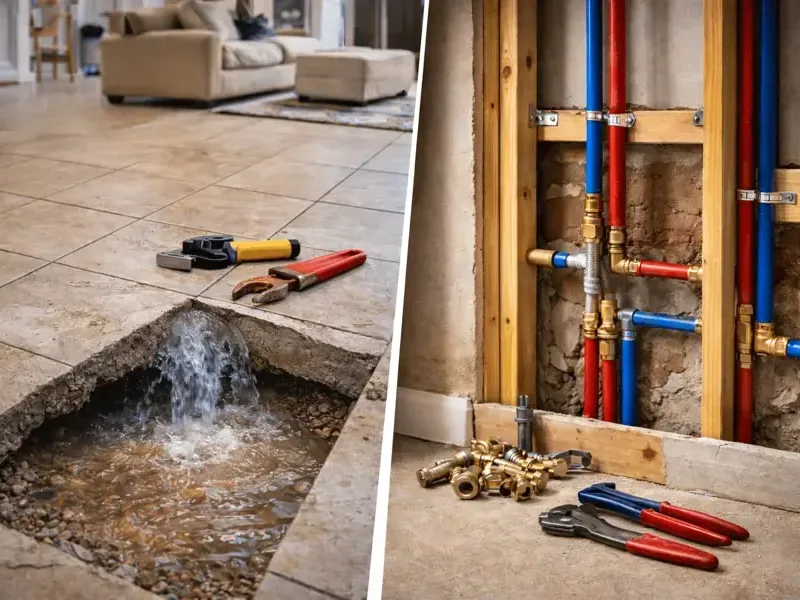
The ranch homes of La Jolla Shores, La Jolla Mesa and Country Club were mostly built from the 1950s to the 1970s, and they sit on concrete slabs. Supply pipes in or under that concrete can fail without a single drip showing, and the first clue is often a floor that feels odd or a bill that jumps.
Key takeaways
- A slab leak is a leak in a pipe that runs in or under the concrete floor, so the water comes up from below rather than down from above.
- Warm spots on the floor, the sound of running water in a quiet house and flooring that lifts or feels damp are the signs worth acting on.
- Hard water wears small holes in copper pipe over the years, which is one reason slab leaks are part of the local pattern.
- A quiet meter check with every tap closed shows whether water is escaping somewhere between the street and the house.
- Finding and fixing the pipe belongs to a plumber, while the drying team extracts, lifts wet flooring and dries the floor system.
Why slab leaks show up in these ranch homes
Homes from the 1950s to the 1970s often have supply pipes routed through or under the slab. Copper was the common choice, and hard water slowly wears pinholes into copper from the inside.
A pinhole under a slab does not drip into a visible space. It lets pressurized water escape into the gravel and concrete, and that water follows the easiest path upward.
The result can be damp carpet or lifting flooring in a room that has no plumbing fixture above it.
Signs a homeowner can see and hear
Slab leaks give mixed signals, so the pattern matters more than any single clue.
- A warm patch on the floor, often a sign that a hot water pipe is leaking beneath it
- The sound of running or hissing water when every fixture and appliance is off
- Carpet that feels damp or smells musty with no spill to explain it
- Tile grout lines that darken, or planks that cup and lift
- Baseboards that stain or swell along one wall
- A water bill that climbs with no change in how the household uses water
A quiet meter check
A simple check helps separate a hidden leak from a normal reading. Close every tap, stop the washer and dishwasher, and make sure no one flushes.
The meter should sit still. A dial that creeps points to water escaping somewhere between the meter and the house, and a slab or wall leak becomes a strong suspect.
That result does not say where the pipe is leaking. It only shows that a plumber's leak detection is worth the call.
How a plumber finds the leak
Pinpointing a slab leak is the plumber's work, and the goal is to open the floor in one spot instead of several. Most of the methods are noninvasive.
Once the spot is known, the repair choices are to open the slab at that point, reroute the pipe through a wall or the attic, or replace the section. The restoration team times its work so equipment is not in the plumber's way and the floor is not closed before the readings are dry.
- Acoustic listening gear picks up the sound of escaping water through the concrete.
- Thermal imaging can show a warm path where a hot water pipe is leaking.
- A pressure test shows whether a section of pipe holds pressure.
- Moisture readings on the floor help narrow down where the water is coming up.
What a slab leak does inside the house
The slab holds water the way a sponge does. Moisture rises into whatever sits on top of it and spreads sideways along the base of the walls.
Carpet and pad
Pad acts like a sponge and holds water against the slab. Carpet and pad over a leak are usually lifted so the concrete can dry.
Tile, wood and laminate
Hard floors hide the problem longer. Wood and laminate swell and cup, while tile can crack or loosen when water collects underneath.
Floors on a slab dry from the top, so the covering often has to come up before the concrete can release its moisture.
Baseboards and wall bottoms
Water wicks upward into drywall and baseboards. The bottom of a wall may need small vent holes or a section removed so the cavity can dry.
What the repair and drying sequence looks like
The order is straightforward, even when the job is not small.
- Shut off the water at the main so the leak stops growing.
- Have a plumber locate and repair the leaking pipe.
- Photograph the wet areas, then lift wet flooring where readings call for it.
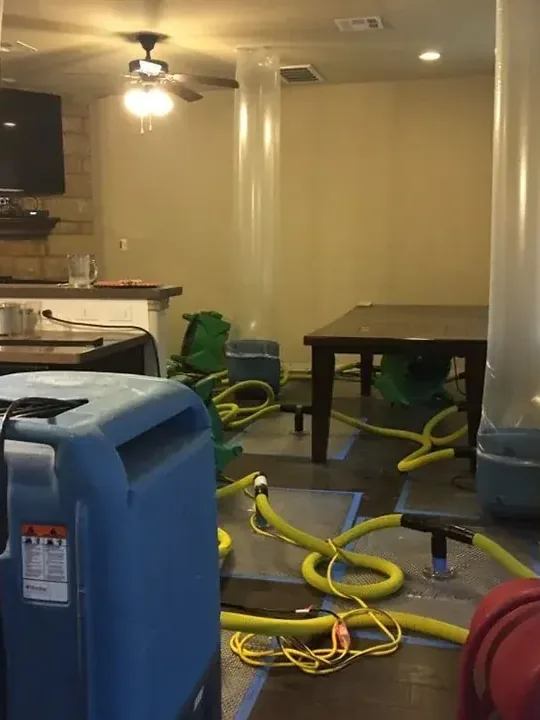
- Extract standing water and set drying equipment across the floor and base of the walls.
- Log readings each visit until the slab, framing and drywall read dry.
Where each trade fits
The plumber fixes the pipe. A slab leak water damage team handles the wet floor system, from extraction to drying and rebuild planning.
Pipes that failed inside a wall or ceiling instead of under the floor are a different job, covered under pinhole and burst pipe leaks.
Why waiting makes it worse
A leak that runs for weeks can soak far more material than one found in a day. Wet drywall, baseboards and cabinet bases stay damp as long as water keeps flowing.
Damp coastal air adds to the problem. In a house on the coast, May gray and June gloom slow natural drying, so a wet slab does not clear on its own.
Once the pipe is fixed, structural drying removes what is left in the concrete, subfloor and walls.
Planning the new floor
Flooring choices come after drying, not before. Matching a new floor across several rooms, handling transitions and deciding whether to replace one room or a run of rooms all depend on what the readings show.
Keeping a record of the leak, the repair and the drying readings helps whoever installs the new floor choose the right moment to start.
Questions
Can a slab leak be fixed without breaking the floor?
Sometimes. Depending on where the pipe is leaking, a plumber may reroute the pipe or reach it through a small opening. The choice belongs to the plumber.
Will a slab leak always show on the floor?
No. Water can travel through gravel and concrete before it reaches a surface, so some leaks are found first by sound or by the meter.
Does a warm spot always mean a hot water pipe?
Often, but not always. A warm spot is a clue that deserves a plumber's leak detection, not a final answer.
Is a slab leak an emergency?
Water is being lost and can spread into the walls and flooring. Closing the main stops the loss while the plumber and the drying team are called, and it keeps the bill from growing.
What happens to hardwood over a slab leak?
Boards take on moisture from below and cup. They are dried with floor mats and readings, and sanding or replacement waits until the floor reads dry.
Can a slab leak affect the ground under the house?
A leak that runs for a long time can soften the ground under a slab. That question belongs to the plumber and, where needed, a structural professional.