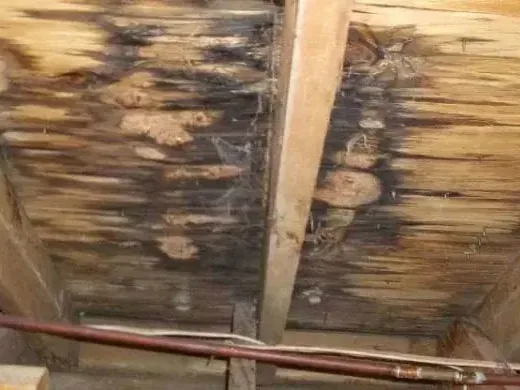
Many mid-century homes here have flat or low-slope roofs, and long dry summers bake the membranes, flashing and sealant around vents and skylights. Then the first big storm of the season tests all of it at once. Water that gets past the roof runs along decking and rafters, soaks attic insulation and comes through the ceiling, often away from the actual leak.
Roof leak or ceiling leak?
A roof leak brings rain in through the building envelope: the membrane, flashing, a vent boot, a skylight or a clogged scupper on a flat roof. It shows up during or right after rain. A ceiling leak from an upstairs bath or a unit above has an interior source and shows up whether it rains or not. The drying is similar; the source and the repair are not.
What the attic drying involves
- Wet blown-in or batt insulation is removed and bagged, since it holds water against the framing
- Roof decking and rafters are checked with meters and dried with air movement and dehumidification
- Ceiling drywall that sagged or stayed wet is opened and removed
- Walls below are checked, because water runs down inside the cavities
A roofer handles the repair and any temporary patch or tarp. The restoration team dries and documents the interior so the claim shows what the storm did. Storm forecasts from the National Weather Service San Diego office give a few days of warning to clear scuppers and gutters, and the California Department of Insurance explains how storm claims work in the state.
Why fast drying matters on the roof side
Plywood and OSB decking that stays wet loses strength and can start to delaminate, and wet insulation loses most of its value. Drying the attic quickly keeps the repair to the roof itself instead of the structure under it.
A flashlight look in the attic after the first heavy rain of the season costs nothing. A stain on the decking is cheaper to fix than a ceiling.