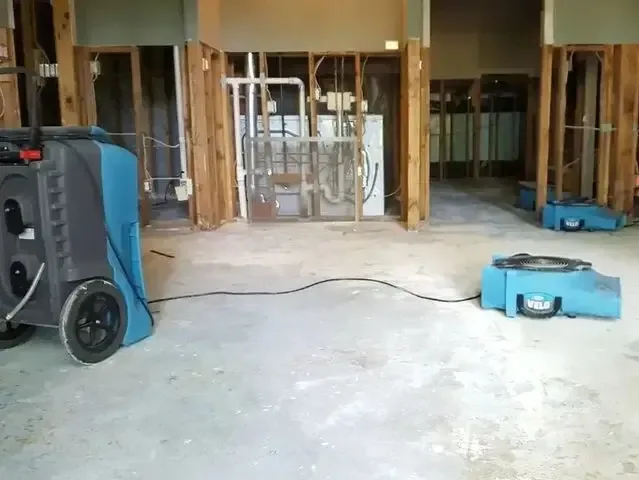
Structural drying is the part of a water job that takes the most time and decides whether the repair stays small. Water that soaked framing, subfloor, plaster or concrete keeps moving into the rooms around it, and damp marine air on the coast slows evaporation, so drying depends on equipment sized to the job rather than open windows.
Classes of water loss
- Class 1: a small area, mostly low-porosity materials
- Class 2: a whole room, carpet and pad, walls wet less than two feet up
- Class 3: water from above, with ceilings, walls, insulation and floors soaked
- Class 4: dense materials such as hardwood, plaster, concrete and stone that hold water
The class sets how many air movers and how much dehumidification a room needs. Class 4 materials often need desiccant dehumidifiers and more days.
How the drying is planned and measured
The tech who does the walkthrough maps the wet materials, then the drying team places air movers to match the evaporation load and runs LGR or desiccant dehumidifiers to pull the moisture out of the air. Each day, psychrometric readings of temperature and humidity and moisture readings of the materials go into the log, and the equipment moves to whatever is still wet.
Drying is finished when the wet materials read within 2 to 4 points of a dry reference, the same material in an unaffected part of the building. That comparison is what the insurer sees in the file. The EPA indoor air quality pages explain why moisture left in a building affects the air inside it.
Older materials dry differently
Plaster walls in early cottages, old-growth framing and thick concrete slabs give up water slowly. Plaster is often dried in place with directed air and small vents rather than torn out, and concrete may need desiccants and tenting. Raised-floor homes need the crawl space under the floor dried too, or the subfloor keeps wicking. The USDA Forest Products Laboratory publishes the research on how wood framing takes on and releases moisture.
Equipment pulled out when the surface feels dry, before the readings say so, is a common reason a dried room smells musty a month later.