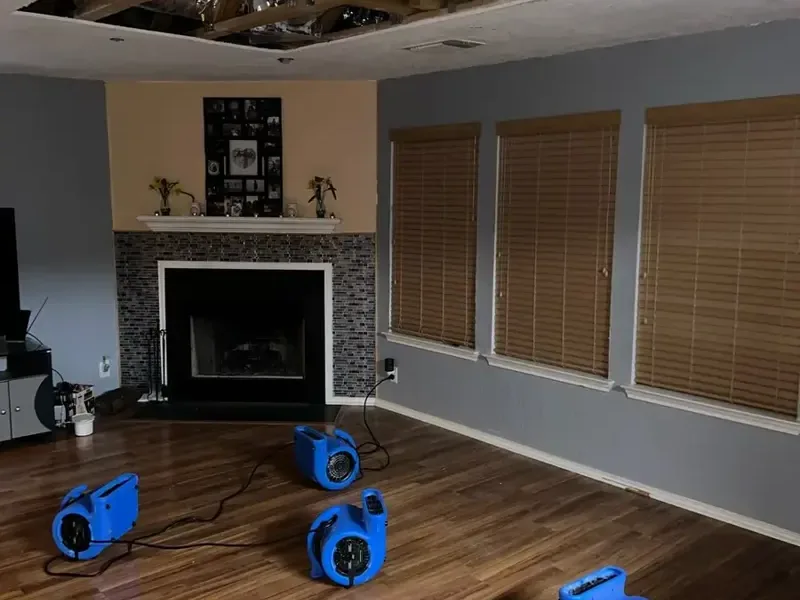
Ceiling drywall acts like a sponge, and a stain is often just the edge of a much larger wet area. Insulation above it holds water against the paper face, so the damage grows after the leak itself has slowed. The sooner the wet section is opened, the smaller the patch that follows.
When the leak starts next door
Multi-family buildings make up 38.4 percent of the housing here, so a ceiling leak often starts in the unit upstairs rather than in the room where the stain appears. A tub overflow, a failed supply hose or a leaking fixture above can send water through floors and down to the ceiling below.
Single-family homes see their own versions of this problem, from an upstairs bath to a pipe running through the ceiling space. Either way, the source gets found and stopped before the drying team can finish, and burst pipe water damage covers that kind of cause.
How the ceiling dries
- The ceiling is cut open at the stain and a little beyond it
- Wet insulation and soaked drywall are bagged
- Joist bays are dried with air movers and a dehumidifier
Walls under the leak are checked with a meter, because water often runs down the framing and soaks the wall bottoms and carpet without showing. Wet drywall left in place can start growing mold within 24 to 48 hours. Lights and fans mounted in a wet ceiling are switched off at the breaker before any cutting starts, and the cut edges are kept straight so the later patch is clean.
Records for owners and associations
With several units involved, written records matter. Photos, moisture readings and dated notes show an owner, a tenant, a landlord or a building association where the water went and when each area tested dry. The water damage cost calculator gives a rough range to start the conversation.